
.svg)


Types of Free Zones and Industrial Zones in Egypt

Egypt is gradually becoming one of the most important platforms for manufacturing, export, and logistics in the Middle East and Africa. For industrial investors and global companies, the decision is no longer based only on land price or factory rent. It is now linked to a complete operating ecosystem that includes the type of zone, proximity to ports, incentives, licensing, infrastructure, labor availability, dry ports, road networks, rail connections, and logistics corridors.
This is why it is essential to understand the difference between free zones, industrial zones, economic zones, and dry ports. Each system serves a different investment model. A company targeting export may be better suited to a free zone or an economic zone. A company serving the local market may be better positioned in a traditional industrial city. A company that depends heavily on container movement and shipping may find proximity to a dry port to be a decisive factor in choosing its location.
What Are Free Zones in Egypt?

Free zones in Egypt are a special investment regime supervised by the General Authority for Investment and Free Zones, known as GAFI. They provide projects operating within them with special customs, tax, and procedural treatment, particularly for companies involved in export, manufacturing, warehousing, re-export, and cross-border services.
Free zones in Egypt are generally divided into two main types: public free zones and private free zones.
Public Free Zones
Public free zones are designated areas equipped with infrastructure and utilities, hosting multiple projects within one defined zone. They typically include customs units, security services, and administrative facilities inside the zone, making them suitable for companies seeking to operate within a regulated and pre-prepared business environment.
Egypt has public free zones in strategic locations such as Alexandria, Nasr City, Port Said, Suez, Ismailia, Damietta, Shebin El-Kom, Qift, and the Media Public Free Zone. The advantage of each location differs according to its position. Alexandria, Damietta, and Port Said are closer to seaports. Nasr City is close to Cairo, Cairo International Airport, and administrative services. Suez and Ismailia are more closely connected to the Suez Canal corridor and the Red Sea, while Qift provides an important opportunity for investment in Upper Egypt.
This type of zone is suitable for companies looking for space within a relatively ready operating environment, with clear procedures and integration with customs and export processes.
Private Free Zones
Private free zones are not necessarily located inside a public free zone. They may be granted to a specific project when its activity, scale, and nature justify such treatment. This model is suitable for major projects that require a dedicated location or specific operating infrastructure, such as large-scale industries, export-oriented projects, or projects requiring special areas or technical specifications.
The advantage of a private free zone is that it gives the investor greater flexibility in location, design, and operation. However, it usually requires more detailed studies and approvals because it is linked to a specific project rather than a multi-company public zone.
Special Economic Zones
The Suez Canal Economic Zone is not a traditional free zone, but it is one of Egypt’s most important investment regimes. It represents a global industrial and logistics platform connected to the Suez Canal and major ports. It includes industrial areas such as Sokhna, East Port Said, Qantara West, and East Ismailia, in addition to key strategic ports.
The advantage of this system is that it does not only provide industrial land. It connects factories directly to ports and international supply chains. For this reason, the economic zone is suitable for companies working in heavy industries, petrochemicals, automotive industries, renewable energy, ship components, warehousing, logistics services, and export-oriented manufacturing.
Traditional Industrial Zones and New Industrial Cities
Traditional industrial zones are areas designated for manufacturing within governorates or new cities. They are suitable for companies serving the local market or regional markets, as well as companies that need proximity to labor, suppliers, and end consumers.
Industrial zones inside new urban cities such as 10th of Ramadan, 6th of October, Sadat, Badr, Obour, and Borg El Arab represent a more organized model because they are located within planned cities that include roads, utilities, residential areas, and service facilities. They are therefore suitable for medium and large factories, multinational companies, and diverse industrial activities.
Dry Ports and Logistics Centers
Dry ports have become a key element in Egypt’s industrial investment map. A dry port is an inland port connected to seaports through railways and road networks. It allows containers to be handled, cleared, and stored away from congestion at seaports.
The importance of dry ports lies in their ability to reduce transport costs, ease pressure on seaports, accelerate export and import flows, and provide nearby factories with a strong logistics advantage. Key examples include the 6th of October Dry Port, as well as planned dry port and logistics center projects in 10th of Ramadan, Sadat, Borg El Arab, Damietta, Beni Suef, Sohag, and other locations.
For an industrial investor, being located near a dry port may be as important as being close to a seaport, because the dry port effectively turns the industrial area into a direct connection point with international trade networks.
The Top 20 Industrial and Investment Areas in Egypt
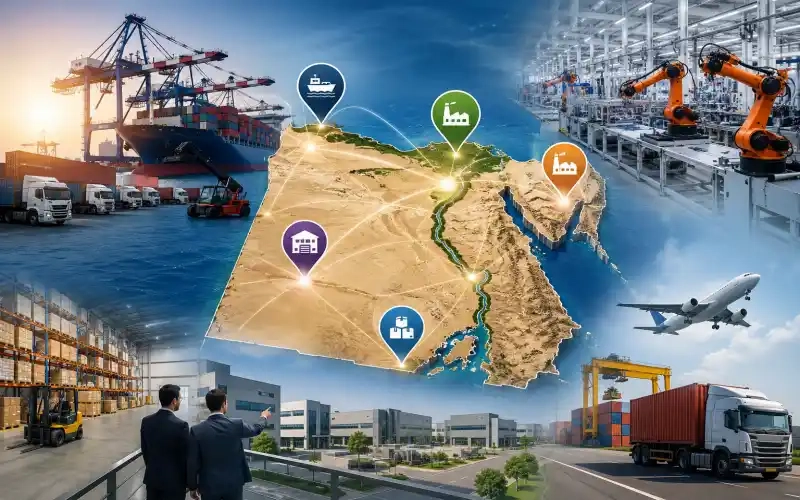
The following ranking is an analytical investment ranking, not an official government ranking. It is based on location strength, scale of industrial activity, proximity to ports or Cairo, labor availability, expansion potential, and the importance of each area within Egypt’s manufacturing and export map.
1. 10th of Ramadan
One of the largest and most important industrial cities in Egypt. It benefits from proximity to Cairo and the Ismailia and Suez roads. It is suitable for engineering industries, food processing, pharmaceuticals, plastics, textiles, and automotive components. The presence of a dry port and logistics center within the 10th of Ramadan area further strengthens its position as an industrial and export hub.
2. 6th of October
A major industrial center west of Cairo, close to Greater Cairo’s market and the main corridors connecting Upper Egypt and Alexandria. It is suitable for food industries, pharmaceuticals, automotive industries, packaging, electronics, and warehousing. The 6th of October Dry Port gives the area a significant logistics advantage.
3. Sadat City
Located between Cairo, Alexandria, and the Delta, Sadat City offers large land areas and competitive operating costs. It is suitable for large and medium-sized industries, food processing, engineering industries, and textiles.
4. Borg El Arab
One of Alexandria’s most important industrial areas, benefiting from proximity to Alexandria and Dekheila ports. It is suitable for export-oriented industries, food processing, pharmaceuticals, engineering industries, and plastics.
5. Obour
Close to Greater Cairo and serving a large consumer market. It is suitable for food industries, packaging, plastics, light industries, and distribution activities.
6. Badr
Its location between Cairo, the Suez Road, and the New Administrative Capital makes it suitable for assembly activities, medium industries, warehousing, and feeder industries.
7. New Cairo / Fifth Settlement
Suitable for clean and light industries, technology-related activities, and service-based operations due to its proximity to corporate headquarters, senior management, and institutional markets.
8. 15th of May
Serving South Cairo, Helwan, Maadi, and the Upper Egypt corridor, it is suitable for engineering industries, building materials, and medium industries.
9. North Gulf of Suez / Ataka
A strong location for heavy and medium industries due to its proximity to Suez, ports, and energy sources. It is suitable for petrochemicals, metals, building materials, and warehousing.
10. Sokhna Industrial Zone
One of Egypt’s strongest industrial and logistics locations within the Suez Canal Economic Zone. It is suitable for heavy industries, automotive industries, energy, petrochemicals, and export through the Red Sea.
11. East Port Said
A strategic location at the northern entrance of the Suez Canal, close to a key Mediterranean port. It is suitable for export, logistics, automotive industries, electronics, and warehousing.
12. Qantara West
A promising area within the Suez Canal corridor, suitable for textiles, food industries, packaging, and logistics. It serves the Delta, Sinai, and the Suez Canal axis.
13. East Ismailia / Technology Valley
Suitable for clean industries, technology, renewable energy, and advanced industrial services. It has a strategic position linking the Suez Canal, Sinai, and new development corridors.
14. Quesna
One of the most important industrial zones in the Delta, close to Cairo and dense labor pools. It is suitable for food industries, engineering industries, garments, and plastics.
15. Southwest Gamasa
Serving Dakahlia, the Delta, Damietta, and Mansoura, it is suitable for food industries, plastics, light engineering industries, and warehousing.
16. Kom Abu Radi — Beni Suef
One of Upper Egypt’s most prominent industrial areas. It has attracted important investments in electronics, home appliances, and engineering industries. It is suitable for companies seeking lower operating costs while remaining relatively close to Cairo.
17. Bayad Al Arab — Beni Suef
A promising area in northern Upper Egypt, suitable for medium industries, food processing, engineering industries, and building materials.
18. Kom Oshim — Fayoum
Close to Cairo, Giza, and Fayoum, and suitable for food industries, agro-industries, packaging, plastics, and light manufacturing.
19. Robbiki Leather City
A specialized industrial cluster for leather, tanning, and complementary industries. Its strength lies not in offering land only, but in creating an integrated value chain for an industry with a long history in Egypt.
20. Damietta Furniture City
A specialized zone for furniture, carpentry, and design, benefiting from Damietta’s historic expertise and proximity to Damietta Port. It is suitable for manufacturing, export, showrooms, and complementary services.
How Should an Investor Choose Between These Systems?
If the objective is export, import, or re-export, a free zone or economic zone may be the better option. If the objective is to serve the local market or manufacture at a lower operating cost, traditional industrial cities may be more suitable. If the activity depends heavily on container movement, proximity to a dry port or logistics center becomes a decisive factor.
Therefore, the decision should not begin with the price per square meter. It should begin with the operating model: Where are the suppliers? Where is the labor? Where is the nearest port? What is the transport cost? How fast is the licensing process? Does the activity require internal customs handling? Is the company targeting the local market or export? Does it require future expansion capacity?
Know more about Egypt’s New Investment Laws 2026
The Role of NileEstate in Supporting Industrial Investors
In this type of decision, it is not enough to search for land, a factory, or a warehouse. Investors need to understand the relationship between location, activity, licensing, logistics, and total cost. This is where NileEstate plays an important role as a platform helping companies and investors access industrial and commercial opportunities inside free zones, industrial zones, economic zones, and areas located near dry ports.
The real value is not only in presenting available space. It lies in helping investors compare alternatives, arrange inspections, understand the differences between zones, and select the location that best fits the activity and growth plan.
Know the differences between Free zones in Egypt and the world
Conclusion
Egypt does not offer only one type of investment zone. It offers an integrated map that includes free zones, industrial zones, economic zones, specialized clusters, and dry ports. This diversity gives investors the opportunity to build an operating model that precisely matches their activity.
Egypt’s real strength does not lie only in its location, market, or ports. It lies in the combination of these elements within one country: a large market, the Suez Canal, seaports, dry ports, industrial cities, free zones, economic zones, and increasing integration with global trade chains.
For this reason, industrial and logistics investment in Egypt represents a significant opportunity for local and international companies, provided that the location is selected based on a complete operational study, not on price alone.
0 Comments
Recent Blogs
A Project Sheikh Zayed
Read more

Free Zones in Egypt
Read more

Usufruct Rights in Commercial and Industrial Land in Egypt
Read more

Egypt’s New Investment Laws 2026
Read more

Free zones in Egypt and the world
Read more
Nasr City Public Free Zone
Read more
Popular Tags
- What Are Free Zones in Egypt?
- Public Free Zones
- Private Free Zones
- Special Economic Zones
- Traditional Industrial Zones and New Industrial Cities
- Dry Ports and Logistics Centers
- The Top 20 Industrial and Investment Areas in Egypt
- 1. 10th of Ramadan
- 2. 6th of October
- 3. Sadat City
- 4. Borg El Arab
- 5. Obour
- 6. Badr
- 7. New Cairo / Fifth Settlement
- 8. 15th of May
- 9. North Gulf of Suez / Ataka
- 10. Sokhna Industrial Zone
- 11. East Port Said
- 12. Qantara West
- 13. East Ismailia / Technology Valley
- 14. Quesna
- 15. Southwest Gamasa
- 16. Kom Abu Radi — Beni Suef
- 17. Bayad Al Arab — Beni Suef
- 18. Kom Oshim — Fayoum
- 19. Robbiki Leather City
- 20. Damietta Furniture City
- How Should an Investor Choose Between These Systems?
- The Role of NileEstate in Supporting Industrial Investors
Leave Comment